
Pre-golden age musical Pal Joey goes through the re-write ringer to become a Rodgers and Hart jukebox musical to mildly entertaining but forgettable overall effect.

You know you’re watching a dance show when the leading man gets dressed after a bedroom love scene and puts his tap shoes back on.
And you know a dance show is in trouble when the comic leads earn the most enthusiastic applause.
This time last year, venerable institution New York City Center, home of the iconic Encores! series, struck gold with their gala season of Parade, which transferred to Broadway and won the Best Revival of a Musical Tony Award. This year’s gala season is a splashy affair, close to fully staged and fully cast, and yet the material itself lets down the show, despite the amount of work that has clearly been expended.
Bowing on Broadway only three years before Oklahoma!, Pal Joey has long been known for a troubled book; not surprising given that book musicals were not quite invented at the time.
Based on the work of John O’Hara (in turn based on his own novel), the new book by Richard Lagravenese and Daniel “Koa” Beaty keeps the same Chicago nightclub setting and roughly the same time period, making the significant change to several lead roles, including Joey, as black characters. (The same conceit was already used last season with Some Like It Hot to more entertaining and impactful effect).
The City Centre Encores! 1995 cast recording of their Pal Joey is an all time gem, making the excising of several songs here a disappointment, not to mention the vastly reduced orchestrations, with a Big Band sound but played a by a not-very-big band. In place of the cut songs are multiple other Rodgers and Hart classics, primarily from The Boys from Syracuse and Babes in Arms (both also memorably recorded after their Encores! seasons).
The jukebox label is particularly apt given that so many of the songs are sung as performances by the night-club characters, ie not in any sort of characterful / storytelling context. Worse still, many songs are not just altered almost beyond recognition but are also frequently interrupted and cut. Only the occasional song that is allowed to really take flight lands with any value.

Joey Evans is a something of a cad, juggling romances to help himself get ahead as a nightclub entertainer. He cheats on sweet singer Linda with wealthy widow Vera Simpson, not that there is much of an impact to Linda discovering this. Mrs Simpson tries to constrain Joey to please high-paying white audiences but on the big night, surprise, surprise, he buckles and blows everything with a performance that is true to his own style.
Pal Joey is co-directed by Tony Goldwyn and tap legend Savion Glover, who also not only choreographs but also performs on stage as part of Joey’s shadowy Greek Chorus of tappers. Several dance sequences reach quite thrilling levels and yet only leave the lasting impression of watching a dance concert.
Triple threat Ephraim Sykes gives Joey his all, walking away with a very respectable lead performance.
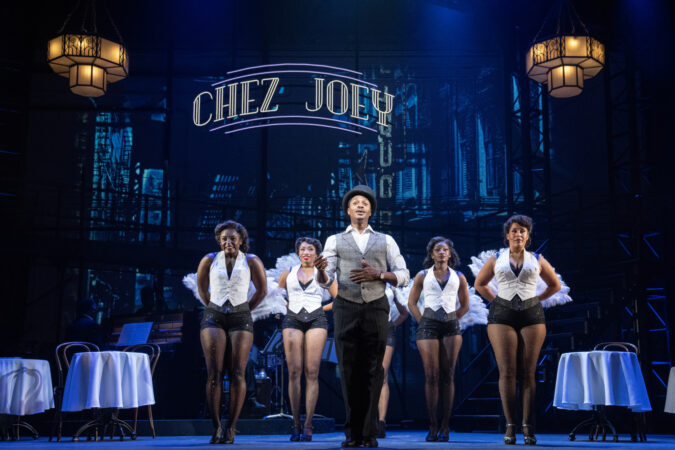
Aisha Jackson charms in the completely underwritten role of Linda, soaring through cherished standards “Where or When” and “My Funny Valentine.”

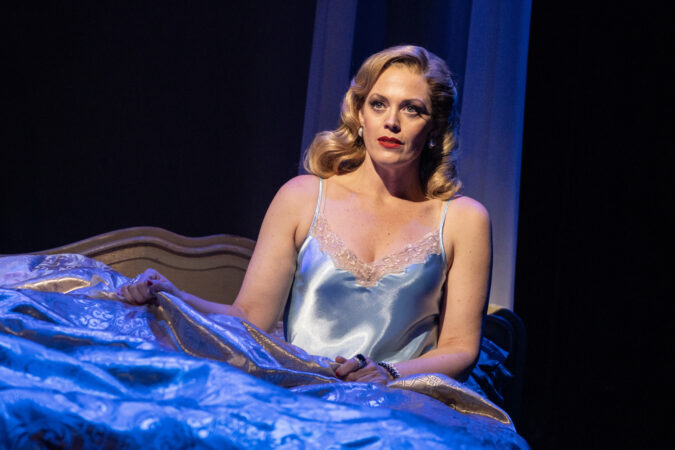
Elizabeth Stanley plays Vera Simpson as just a little too modern and unencumbered by morals; she does, however, sing a meticulously calibrated rendition of Pal Joey’s most enduring hit “Bewitched, Bothered and Bewildered,” starting soft and low before building to a genuinely stirring climax.
Switched to a male performer, columnist Melvin Snyder provides Brooks Ashmanskas with choice cameo number “Zip,” in which he readily delights the audience.
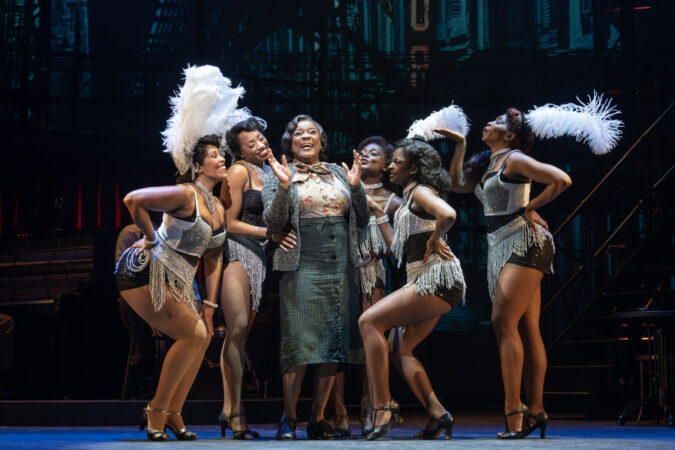
Basically stealing the show is Broadway legend Loretta Devine, nailing every comic line and singing and dancing with her trademark lashings of infectious verve.
If this season is a bust, there is no telling when or if Pal Joey will see the stage again. At least the world still has the 1995 recording.
Pal Joey plays at New York City Center until 5 November 2023. For tickets, click here.
Photos: Joan Marcus
Categories: Broadway, Music Theatre, Reviews
 Man in Chair
When will companies learn to leave well enough alone!
You know, I was excited to learn there was a revival, and was ready to shell out, in spite of truly outrageous ticket prices (Over 500 dollars for orchestra! Almost twice what front orchestra tickets for Hamilton run! I wonder how many empty seats there were for the limited run).
Then I realized they’d gutted the story, turned Joey from heel to hero, slapped on a happy ending (just like the Sinatra movie did, and that’s the real influence here, up to and including the anti-heroine singing The Lady is a Tramp from Babes in Arms) and turned the proceedings into a truly bizarre exercise in fashionable woke-ism. The theme is white musicians and businesspeople ‘appropriating’ black music. Huh?
The retroactive partnership between jazz musicans of all races and backgrounds and Rodgers & Hart is legendary, and has led to some of the most beautiful recordings ever made–but Rodgers & Hart were not black, not jazz musicans, and were frankly rather skeptical about jazz–Hart didn’t much like the (mostly white) swing bands of that era’s interpretations of his stuff, though I think that’s partly because the lyrics got cut and watered down for time considerations and because Hart’s stuff was too spicy for radio then. (In other words, they made it whiter–but it still wasn’t appropriation–just how business was done then).
It took longer for black jazz players to get on the R&Hart bandwagon, but that still didn’t mean black musicans were ‘appropriating’ anything–artists borrow ideas from each other, and there has never been anything wrong with that. As long as nobody’s copyrighted work gets used without credit. I read somebody refers in a derogatory way to Bing Crosby, for ‘stealing’ black music. Nobody owns a style, and Bing could sing. He respected black players, they respected him. There’s no reason to think that a racist country was going to buy more records cut by black people becuase white people stuck to their patch–as if Jazz wasn’t full of ideas ‘appropriated’ from western music.
But here, we’re somehow supposed to think Joey Evans wrote the songs himself, or that they somehow belong to black musicans–because? I guess because the producers shelled out for the rights to the priciest ones from the estate? Maybe that’s why the tickets were so pricey?
Yes, the old books for the R&Hart musicals are problematic in many ways, though I’d still like to see them done right. A lot of Shakespeare plays are problematic, and so are Gilbert & Sullivan operettas, but people still like to see those done right.
All they did here was make something a hundred times more problematic. And bury the potent profound meaning of these songs under a pile of pious horse manure.
This new Pal Joey certainly was a disappointment overall. What could have been a nostalgic musical treat turned into a dull mess. Who knows if we will ever see this property again in any form.
Even if it had been a great and faithful production, such a short run wouldn’t have been sufficient to revive interest in the canon. I think maybe the model being used for these revivals has been wrong.
Hart, as you may know, was a rabid Gilbert & Sullivan fan. He went to see the operettas every chance he got sometimes once or twice a week. He clearly was hoping to create an American answer to them with Rodgers, and I’d say he succeeded, but it took him time to figure out how to write something other than lyrics. There’s only a few of their musicals that are really worth staging now. Pal Joey, for sure. Babes in Arms. On Your Toes. Perhaps A Connecticut Yankee and a few others. And all of them will be in the public domain in a short time. And once that happened with Gilbert & Sullivan, what mainly happened was more creative but still very faithful and respectful productions, where actor/singers simply demonstrated their deep love of the work, and accepted the modest pay involved, as is still the case with the New York Gilbert & Sullivan Players. (Though they did run into some unfortunate problems with The Mikado–honestly, it would be nice if virtue-signalers had actual virtue, and weren’t just out to promote themselves.
At that point, small repertory companies could stage them without having to pay the Rodgers estate (which rather shamelessly cheated the Hart family out of its proper share of the proceeds after Hart’s death).
Today, most of the musicals could benefit from diverse casting–the only challenge there is, oddly, the most diverse musical of its time–Babes In Arms, which directly challenged segregation in 1937 and therefore you’d destroy the point it was making by changing up the ethnicities. It was widely praised in black newspapers at the time for its stance, but Wokeism oddly tends to care more about surface appearances than content of character now, which is what this new production of Pal Joey is plagued by.
The love for the songs remains. And I kind of think today it’s the Rodgers & Hammerstein canon that’s looking a bit dated, in spite of better books–Hart’s bohemian ethos might be more in tune with the present era, with just a bit of work.
These plays belong to the world–there is no appropriating them. We all have a right to enjoy them, and anyone who can sing and act well has a right to perform them. Soon that right will not come with a price tag. And then we’ll see.
The Boys from Syracuse is another Rodgers and Hart show I love. City Center’s earlier runs of these shows led to fantastic cast recordings – The Boys from Syracuse, Babes in Arms, and Pal Joey. I treasure these cast recordings. Wonderful singers and lush orchestras.
I didn’t know about Hart’s interest in operettas, nor I was aware of the context of Babes in Arms.
I share your interest in what might happen with performances of these shows when they are out of copyright.
Should have mentioned that. But I’ve only read about these shows, and heard many of the songs. I really enjoyed A Ship Without a Sail–the song, but also the biography of Hart by that title. It is, you might say, a hart-breaking story, but at the same time an inspiring one. He made so much beauty out of his pain–and his sheer love of life’s variety.
The context in Babes in Arms is they need to put on a show to stay out of a work camp in the Depression. Val, the hero, knows these two brilliant young tap dancers–played by The Nicholas Brothers in the original production–and when a young backer who is from the south threatens to pull out his money if they’re included, Val ultimately tells him where he can get off. Billie, the free-spirited heroine, figures there’s some kind of compromise that can be worked out, but Val won’t budge an inch. What’s right is right. They’re good, and they have as much right to strut their stuff as the white kids. And watching him stalk off in a huff, she sings My Funny Valentine. Because she knows now, he’s the only one for her. Not a hair would she change. That must have been incredibly powerful to watch. I hope I can watch it someday. You sure as hell don’t see it in the movie MGM made. Which doesn’t even have that song in it. ::sigh:: What a waste of Judy Garland and Mickey Rooney. Ideal casting. LOUSY script. So let’s just say, R&Hart were getting butchered a long time before this latest fiasco. For oddly similar yet different reasons. People keep refusing to get the point, and surface appearances matter more than what’s underneath. And of course, the figures absolutely must be Greek. 😉