
In a splendid realisation of an inspiringly ambitious vision, Melbourne Opera successfully brings opera to world heritage site, the Royal Exhibition Building. The combined result of dozens upon dozens of artists and creatives, Die Meistersinger von Nürnberg delights with its sheer quality and glorious music.
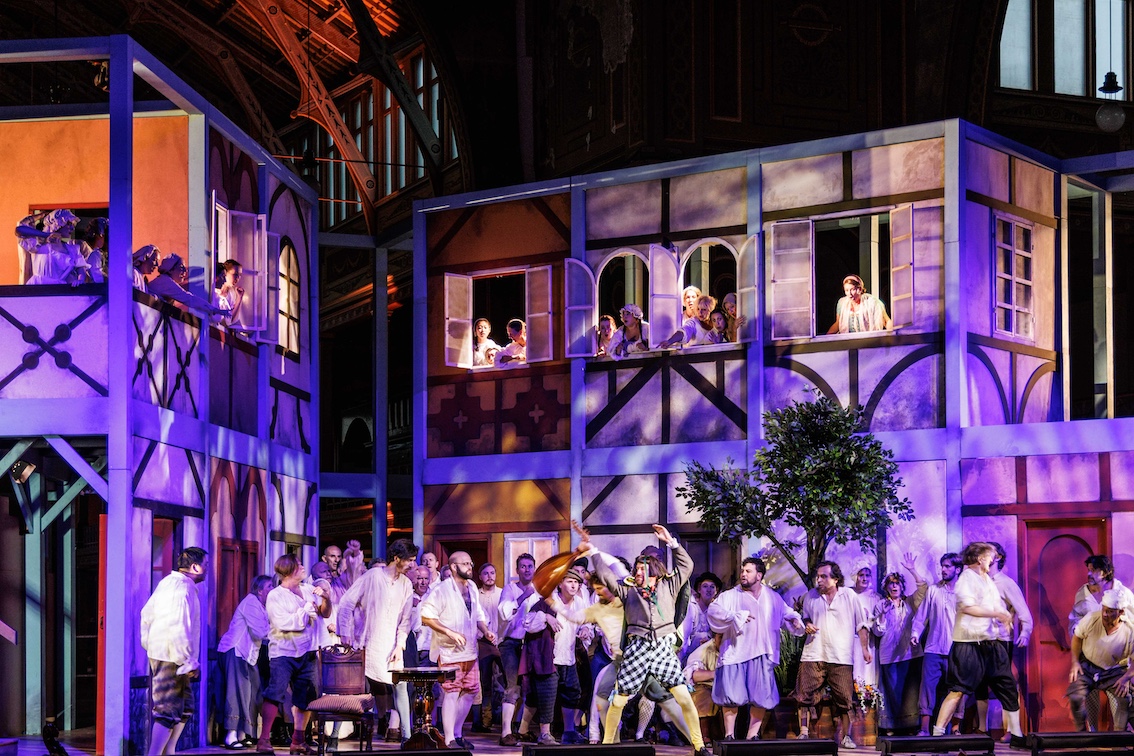
Serving as both a reflection and a celebration of the elevating power and beauty of music, Die Meistersinger von Nürnberg gently mocks the restrictive rigours of bureaucracy whilst championing the value of the arts in upholding tradition and scaffolding community.
Known as Wagner’s only comedy, Die Meistersinger von Nürnberg is filled with quirky characters and sweetly romantic stakes. Walther von Stolzing arrives in Nürnberg and falls in love with Eva, whose father has offered her hand in marriage as prize for a song contest. Wishing to become a Mastersinger and win Eva’s hand, Walther is supported by noble cobbler Hans Sachs and opposed by cantankerous fellow suitor Sixtus Beckmesser.

Die Meistersinger von Nürnberg was last seen locally in 2018 in a spectacular co-production that dazzled the audience but seriously muddied the storyline with its modern, high concept setting.
With judicious focus, director Suzanne Chaundy crafts the comedy with the lightest of touch, simply allowing the inherent humour of the characters and action to speak for itself. Storytelling is crisp, clear, and engaging. As with the best comedy, the action is played as though it is of high importance to the serious characters.
Inspiring total musical confidence from the very first notes, maestro Anthony Negus reliably draws the finest possible playing from the near 60-strong Melbourne Opera Orchestra. There are inherent risks to performing live music in an untested venue; happily, the orchestral music rings out with vibrant clarity, blending sweetly with the stirring vocals.
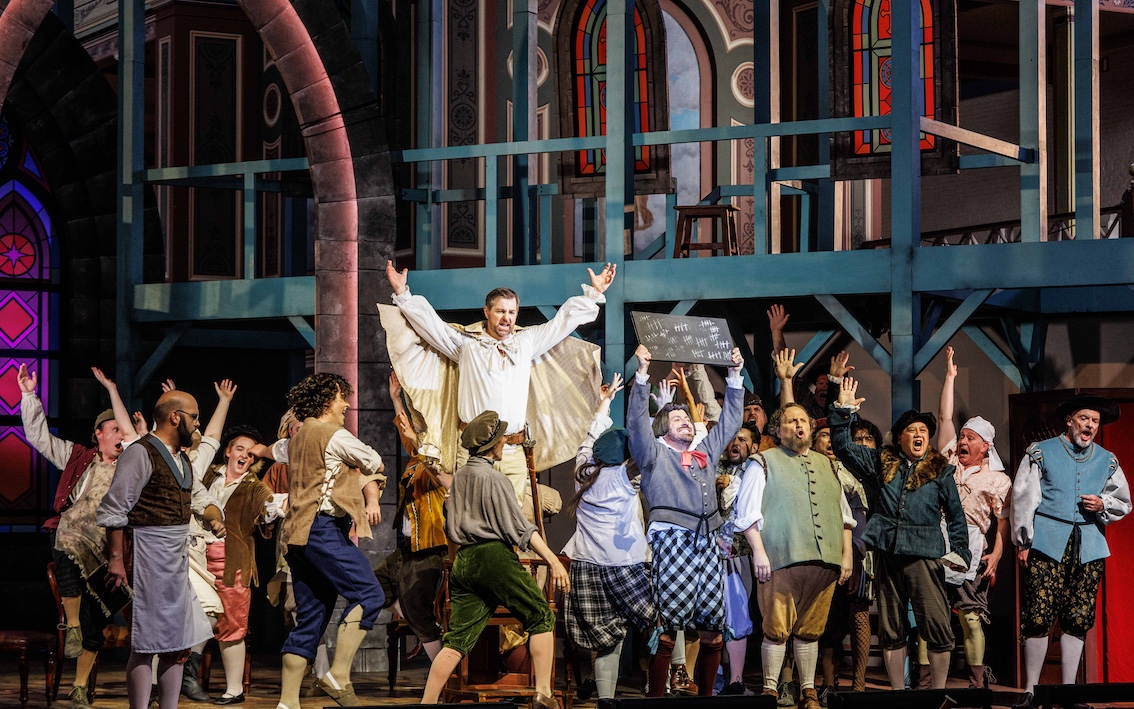
The soaring arches and central dome of Royal Exhibition Building prove a stunning backdrop for opera, and designer Andrew Bailey has deliberately complemented the existing colour palette with his scenic design. Even with large settings on the stage, the grand space still provides a view of singers coming and going from the performance area, much like the effect of an outdoor Shakespeare production.
With the logistics of installing blackout blinds completely unmanageable, lighting designer Philip Lethlean instead embraces the natural light, which gradually alters from the 3pm start to the eventual conclusion more than six hours later (including two generous intervals). Twilight seems to arrive on cue for the climactic grand final scene of the St John’s Day festival and song contest. Subtle spotlights are used throughout to highlight principal singers.
With the performance space set up for tiered seating of 1200 patrons, interval breaks at the light, airy venue have the casual warm atmosphere of an outdoor festival, with local opera cognoscenti happily enjoying the shared experience. In a classy touch, a bright brass fanfare heralds the time for the audience to take their seats before each act.
Bailey’s initial framework sets portraying St Katharine’s Church are supplemented over the first interval, adding the charming facades of a bustling village. Act three begins with the facades removed and Sachs’ workshop taking centre stage. During the interlude, the workshop is struck and the company processes the length of the Building, twirling ribbons and proudly carrying banners to the full-stage outdoor festival. The design overall is simply in line with Wagner’s original time and place of mid-1500s Nuremberg, a local centre of the Renaissance.
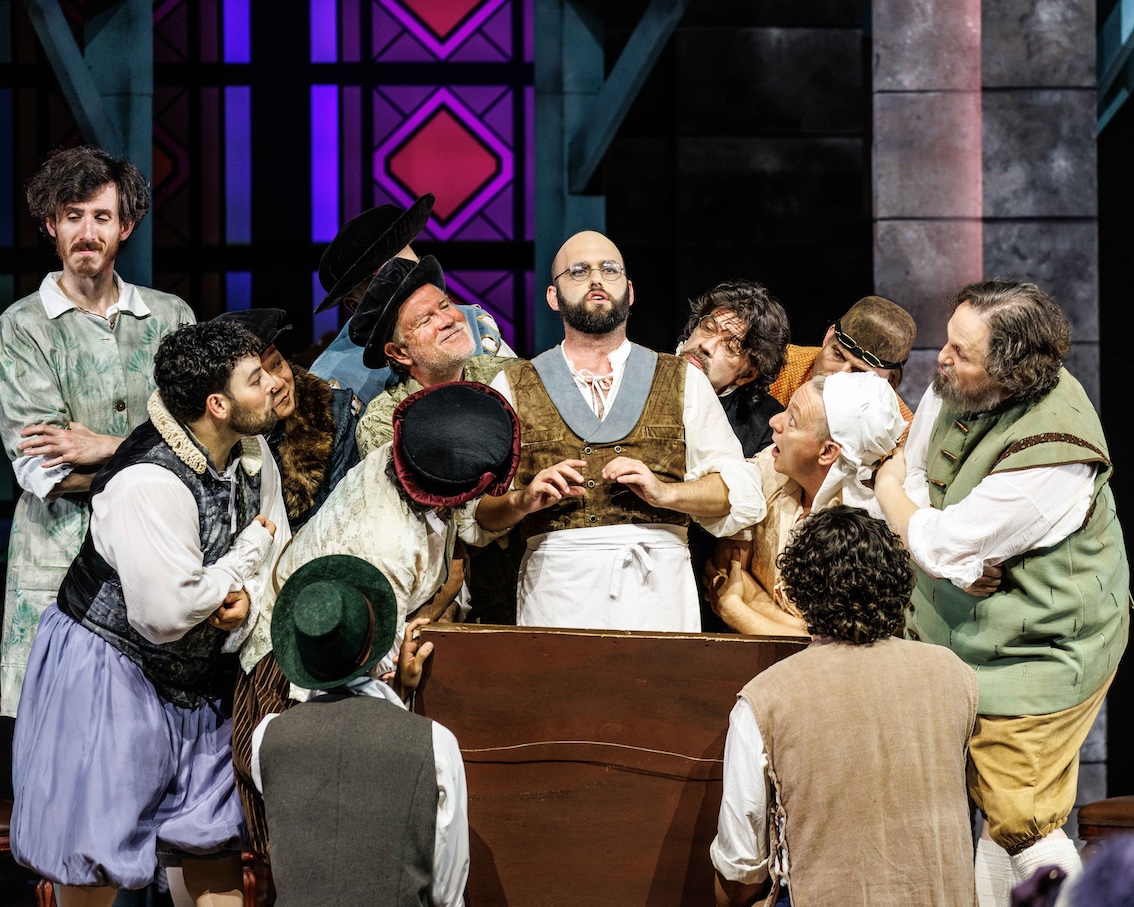
Costumes, by Karine Larché, complement the same gently muted palette of the sets, often adding cheeky flourishes of humour to proceedings. Festival costumes are suitably grand, finished appealingly with colourful floral headwear.
Having presented much of Wagner’s repertoire, including their unforgettable Bendigo Ring Cycle, Melbourne Opera now boasts a core of richly experienced singers of Wagner. Not only is it impressive to see all roles in Die Meistersinger von Nürnberg taken by Australian singers, but to have a set of principal and featured singers so evenly matched in quality is a real thrill. Act one, in particular, spotlights numerous soloists, each as strong, exact, and characterful as the last.
Act two draws the focus in more tightly, with revered Wagnerian expert Warwick Fyfe sharing a direct bond with audience as Hans Sachs reflects on Walther’s initial attempt at song in the Flieder monologue, “Was duftet doch der Flieder.” Fyfe’s meticulously calibrated, neatly understated performance of the epic role of Sachs continues across acts two and three, his rich vocal expression deftly balancing Sachs’ curmudgeonly temperament with an underlying heart of gold. By the time the ensemble sings a tribute to the noble cobbler Sachs, the same sentiment could very well be applied to the galvanising and stirring work of Fyfe himself.
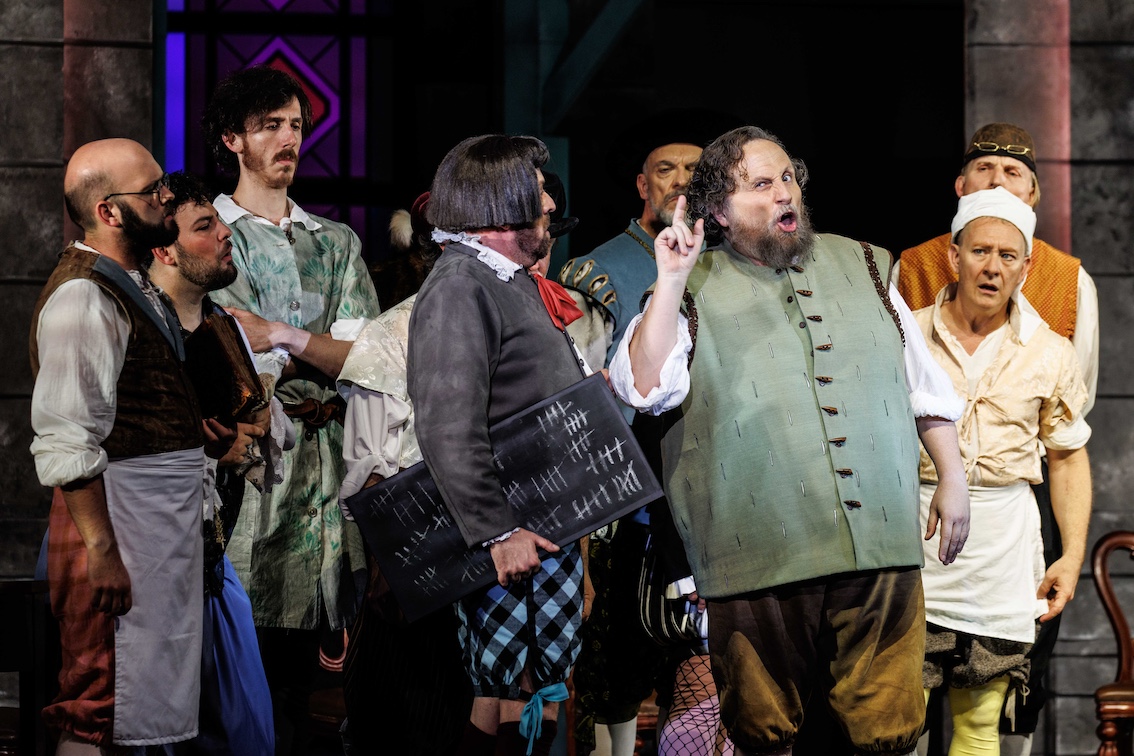
Amusingly delivering the broadest of the characterisations, Christopher Hillier nonetheless grounds buffoonish Master Sixtus Beckmesser with serious, self-important intent. Despite Sachs’ harsh marking of Beckmesser’s love song, Hillier sings with wonderfully rich warmth. Much as their characters are bitterly bickering, to hear baritones Fyfe and Hillier together is a joy.

While the idea of men competing to win a woman’s hand is hopelessly outdated, Lee Abrahmsen is certainly presented by designer Larché as an appealing “prize,” all golden curls and pale pink gown. In lustrously golden voice as ever, Abrahmsen demurely leaves the audience wanting more in this decidedly male-centric opera.
Abrahmsen is winningly partnered by sterling leading man James Egglestone, singing Walther with heroic passion and ardently romantic tone. Egglestone delights the audience with Walther’s “Morning Dream Song,” saving plenty of sumptuous vocal tone for the climactic contest performance.
Abrahmsen also works beautifully with richly experienced mezzo-soprano Deborah Humble, who elevates the supporting role of Eva’s nurse / companion Magdalena with her pristine vocals and sweetly coquettish stage presence.
Tenor Robert Macfarlane gently adds to the air of comedy as Sachs’ apprentice, David. Given less melodious music that of the hero Walther, Macfarlane nonetheless sings with crisp expression and appealing tone.
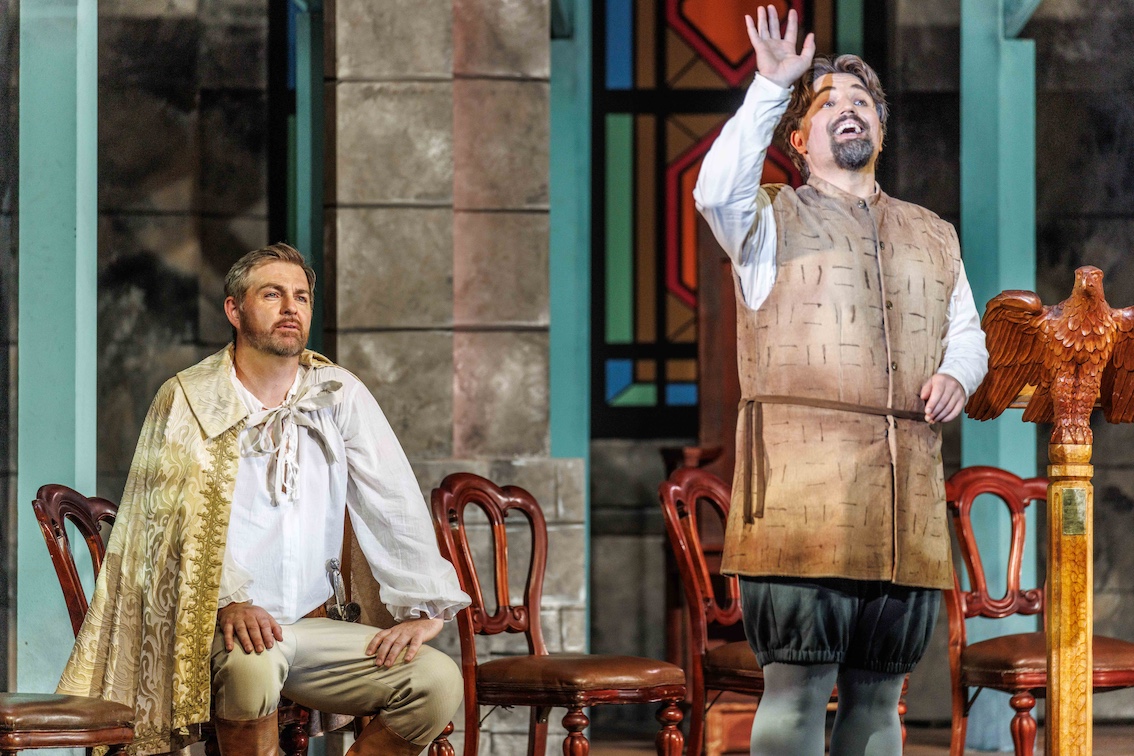
Invaluable featured singer Steven Gallop sings the role of Eva’s imperious father Pogner with his all too rare blend of pristine technique and rich character.
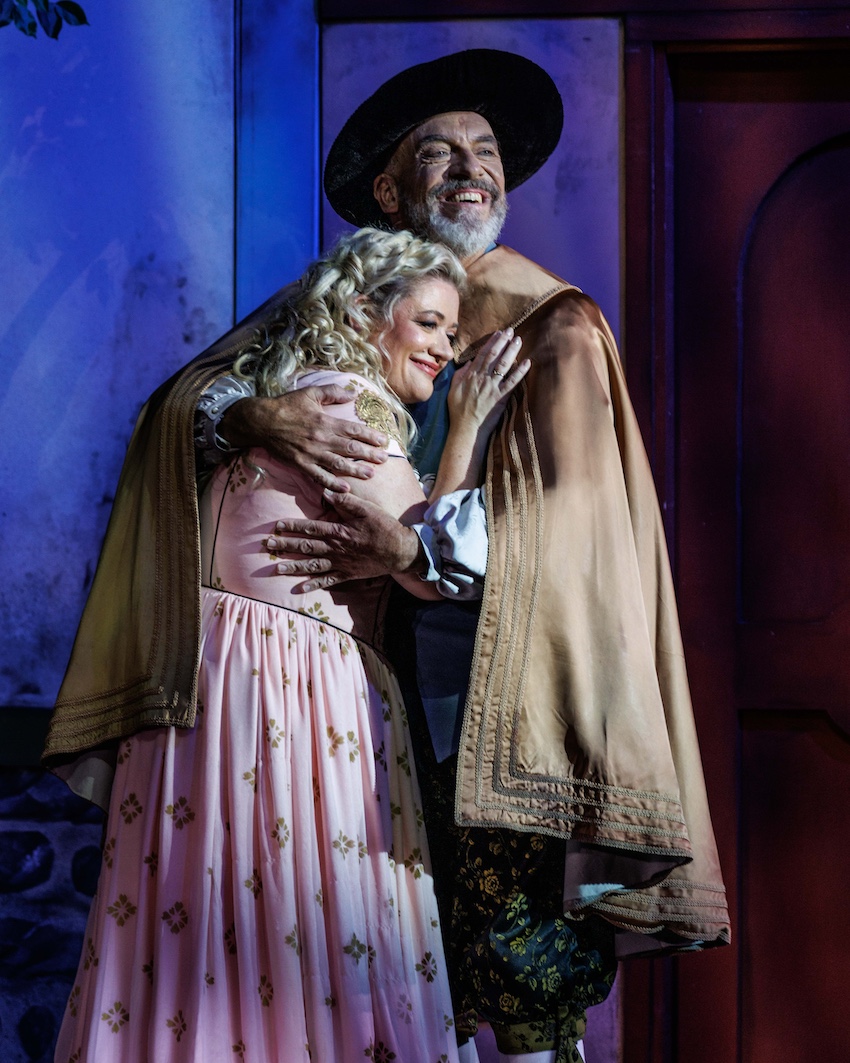
The production is blessed with a highly experienced set of singers playing the Masters, each of whom imbues their role with distinctive personality and presence. The Apprentices are sung by a younger cohort, matching strong vocals with lively stage presence. In a very suitable modern touch, the set of ten male apprentices includes both male and female singers.
The Melbourne Opera Chorus sings out with rich harmonies and glorious power, beginning the opera from afar at vespers and later palpably raising the performance energy in the final scene of the opera. Expert preparation by chorus master Raymond Lawrence is clearly evident throughout the opera. Movement director Lisa Petty enlivens proceedings with merry dance.
With our national company seemingly incapable giving Melbourne opera audiences anything like this sort of high quality experience, local opera lovers are strongly urged to embrace this unique and memorable season of Die Meistersinger von Nürnberg.
Die Meistersinger von Nürnberg plays select dates at Royal Exhibition Building, Melbourne until 22 February 2025. For tickets, click here. To view food and drink options, click here.
Photos: Robin Halls
 Man in Chair
Simon, thanks for this review. I can only heartily agree about the strength of the male singers in Act 1. I was unfortunately seated 3 rows from the front, stupidly thinking for once I’d spend up big for a “special “production. I knew it was a mistake as the first notes of the overture sounded. Mud! Very heavily bass oriented and “amplified, as well. Why amplification? The higher strings may as well have been sawing wood as their sound was non existent. So dreadfully disappointing. That, and the sincerely uncomfortable seating meant I was unable to experience the rest of the production. Unfortunately I was not alone in this feeling, a number of attendees were leaving at the same time for the same reasons. I was so disappointed to not experience the work as a whole.
Sorry to hear this, Warrick. I was fortunate enough to be at the front of the second block of seats, which was ideal.
If you are keen, I recommend contacting Melbourne Opera with your feedback and they may well provide new tickets for another date.
thanks fir your response Simon. Perhaps I will do as you suggest. There are plenty of empty seats on both Tuesday and Thursday evening. Not well booked at all. It doesn’t alter tge fact at all though, Simon, that the sound ought to have been checked for perfirmances and this ought not have occurred. Seriously the high strings may as well have not been there at all. Sigh!
Hello Simon. A very interesting review, and I’m looking forward to seeing the production on Sat. I was really wondering how they would manage the acoustics of the building, and reading Mr Dawson’s comment, I’m a tad concerned. I am, however, not sitting in the first 3 rows – something I would never do for any production – so I am therefore waiting with great anticipation. We are so fortunate to have a city based opera company that does such truly outstanding productions, and in my mind even better than the “so called” national company that is Sydney centric.
Mr Fyfe is an exceptional singer, and he can act too! Ms Abrahmsen is also a wonderful artist; I recall her stunning “Isolde” from some years ago.
Really looking forward to the performance, although the seating doesn’t look all that comfortable, and having sat in the seats in the Bayreauth Festspeilhaus, I can say that this is very much in the Wagnerian tradition – we have to suffer for our art experience! LOL!
Thanks, Christopher. Glad to hear that you are attending Meistersinger. I was in row KK and I feel that anywhere back from there would be good.
The singers you have mentioned are in top form. The uniform quality of the cast is very noticeable.
Some people brought along a cushion so you should feel free to do that!
While Melbourne Opera’s attempt at Richard Wagner’s “Die Meistersinger von Nuernberg” is quite commendable and the venue, interesting with excellent singers, it can’t erase the wonderful memories of Opera Australia’s picture book Michael Hampe production at the Sydney Opera House some years ago with the wonderful Michael Gluecksmann as Hans Sachs in the best Theo Adam tradition, capturing every nuance vocally and histrionicly. I remember him being partnered by the great John Pringle, Amanda Thane and Horst Hoffmann.
Thanks, Guido.
I believe that particular production played in Melbourne as well but I was not fortunate enough to see it. Sounds like a wonderful memory.
I suppose it could be said that Opera Australia were working with a larger budget thanks to government funding. Melbourne Opera continues to conjure miracles from private sponsorship and ticket sales.
we were sitting up the back in row UU so we had a great view and sound. Sadly was not fully booked and we moved a few rows down for the 3rd act. But the higher up seating gave you great views and perhaps better musical balance. I could have done with only 40 mins for the second interval though. 40 mins plenty I thought…even having to queue for coffee.
It may be ‘Known as Wagner’s only comedy’ but incorrectly so.
Fair point, Peter. I probably should have said Wagner’s best known or most widely performed comedy.
Hope you had a chance to enjoy this production.
I went to the Sat 22/2 performance. Musically, in terms of the orchestral playing, the cast, including the chorus, were wonderful. Acoustically, the venue I feel, however, was not suitable. I was sitting about 2/3 of the way up. The brass, and most of the string section, depending on which register they were playing in, were mostly clear. The woodwinds, and in particular, the upper WW (Fls/Ob) were generally “swallowed” by the acoustics and I found them quite difficult to hear; this was disappointing considering the quality of the orchestra. In particular, I’d like to mention the Fr Hn section where there was some really lovely playing (in Act 2 from memory).
The weather on Sat 22/2 was very hot in Melbourne, and it was almost as hot inside the Exhibition building as it was outside. Obviously the company has no control over the weather, but this needs to be taken into account, especially if the performances are in summer. Some patrons sitting near me did not return for Act 2, and it can’t have been for the overall performance standard but more for the extremely uncomfortable conditions, for the audience, and the orchestra, and most likely the cast. I have sat in the hard slightly padded seats in the Bayreuth Festspeilhaus, and the plastic folding chairs with added “padding” were not much better.
Overall, musically the performance was fabulous but the venue was very disappointing and I hope as an experiment that it is not repeated.
Thanks for this update, Christopher.
I think I was very lucky with the weather at the opening performance. I could see that there were only small fans on offer and no a/c. Must have been very hot that day, especially for the performers.
Not sure whether the sound was better where I was sitting. You may have a more detailed knowledge of the score and a final ear for musical detail. In regard to instrumental and vocal balance, I was very pleased.
As an experiment, it was a worthy one. Perhaps the Palais Theatre will remain the venue for future large scale productions.